
A railroad pocket watch is a timepiece built to the strict accuracy and legibility standards that American railroads imposed on their crews from the 1890s onward. To qualify as “railroad grade,” a watch had to be open faced, lever set, finely adjusted, and fitted with a plain white dial carrying bold black Arabic numerals that could be read at a glance. Those rules were written after a deadly collision showed what a few lost minutes could cost. This guide explains where the standards came from, how to recognise a railroad-style watch today, and what to look for if you want a piece with the same look on your own chain.
The Kipton Wreck: Why Railroads Started Policing Watches
In April 1891, two trains of the Lake Shore and Michigan Southern Railway collided head-on on a single-track main line near Kipton, Ohio. An eastbound fast mail train had the right of way, and a westbound passenger train was supposed to clear the main line at Kipton station and wait on the passing track. It was still on the main line when the two trains met. Both engineers and several postal clerks were among the dead.
The investigation that followed is the reason railroad watches exist as a category. It concluded that the passenger train conductor’s watch had stopped for a few minutes and then started running again, leaving its owner several minutes behind the real time. On a railroad that ran on timetables and written train orders, that gap was enough to put two trains in the same place at the same moment.
The railroad hired Cleveland jeweler Webb C. Ball to investigate and to set up a system of time inspection. Ball worked out a set of requirements for the watches crews carried, plus a network of local inspectors who checked and recorded each watch at regular intervals. Other railroads adopted similar programs, and by the early twentieth century carrying an approved watch was a condition of employment for many train crews in the United States and Canada.
Railroad Grade Standards: What Made a Watch “Approved”
There was never one single national rulebook. Each railroad published its own list of approved watches, and the requirements tightened over the decades. Still, the core of the General Railroad Timepiece Standards that grew out of Ball’s work is consistent across most lines:
- Open face case. Hunter cases with a lid were not allowed. A railroader had to read the time instantly, with one hand, often while holding a lantern or a train order in the other.
- Winding crown at 12 o’clock. The stem sits at the top of the case, in line with the 12, so the watch hangs and reads naturally in the hand.
- Lever setting. To change the time, the owner had to open the bezel or crystal and pull out a small lever before turning the crown. This prevented the hands from being knocked out of position by accident, which could happen with ordinary pendant-set watches.
- Size 16 or 18. These were the standard American movement sizes, large enough for a readable dial and a robust movement.
- At least 17 jewels. Later standards often called for 19 or 21 jewels to reduce friction and wear.
- Adjusted to temperature, isochronism and at least five positions. The watch had to keep good time in heat and cold, whether fully wound or nearly run down, and whether held dial up, dial down or crown up, left or right.
- Accuracy within about 30 seconds per week. Inspectors compared each watch with a standard clock and logged the result on an inspection card.
- A plain, legible dial. White enamel, bold black Arabic numerals, clear minute markings and a distinct seconds subdial. Fancy Roman numerals and decorated dials were generally not accepted.
Some railroads went further. The Montgomery dial, for example, prints a small number beside every minute marker around the edge so the exact minute can be read without counting ticks. In parts of Canada, where railways adopted the 24-hour system early, dials with an inner 13 to 24 ring became common, which is why a 24-hour track still reads as a “railroad” detail to many collectors.
For a deeper technical background on how these timepieces were tested and certified, the Wikipedia entry on the railroad chronometer is a good starting point.
How to Recognise a Railroad-Style Pocket Watch
If you are browsing antique shops, estate sales or online listings, these checks will quickly tell you whether a watch follows the railroad pattern:
- Look at the case. A true railroad watch is open faced. If there is a front lid that covers the dial, it was not built for railroad service, whatever the listing says.
- Find the crown. It should sit at 12. A crown at 3 o’clock usually indicates a converted hunter movement or a sidewinder, which railroads did not approve.
- Read the dial. Bold Arabic numerals on a light background, a full minute track and a separate seconds subdial are the signature look.
- Check the movement markings. On genuine antiques, the movement is often engraved with the jewel count, “adjusted” and the number of positions. Well-known railroad models include the Hamilton 992 series, Ball Official Standard, Waltham Vanguard, Elgin B.W. Raymond and Illinois Bunn Special.
- Look for a setting lever. Open the bezel and you should find a small lever at the edge of the dial, usually near 5 or 1 o’clock depending on the maker.
A word of caution: “railroad” is used loosely in modern listings. Many new watches with a locomotive engraved on the cover are called railroad watches even though they are hunter cased and decorative. Fine for a train-themed gift, but not a railroad grade watch.
Antique Railroad Grade vs. Modern Railroad-Style Watches
Before you buy, decide which of these you actually want. They serve different purposes.
| Feature | Antique railroad grade watch | Modern railroad-style watch |
|---|---|---|
| Movement | Mechanical, hand wound, highly jeweled and adjusted | Usually quartz or a simple mechanical movement |
| Certification | Built to a railroad’s approved list and inspected | Inspired by the look, not certified for service |
| Upkeep | Needs periodic servicing by a watchmaker | Low maintenance; quartz needs a battery change |
| Best for | Collectors, horology enthusiasts, heirloom pieces | Daily wear, gifts, costumes, rail enthusiasts |
| Main risk | Married cases, replaced dials, hidden wear | Loose use of the word “railroad” in listings |
For history and mechanics, buy an antique from a known maker, verified by a watchmaker. For the classic look without servicing schedules, a modern railroad-style piece makes more sense.
How to Choose a Modern Railroad-Style Pocket Watch
When you shop our railroad pocket watches, use the original standards as a checklist for style rather than certification:
- Legibility first. Pick a dial you can read in half a second. High contrast between the numerals and the background matters more than decoration.
- Open face if you want authenticity. Browsing the open face pocket watch range is the quickest way to find dials that sit closest to the railroad pattern.
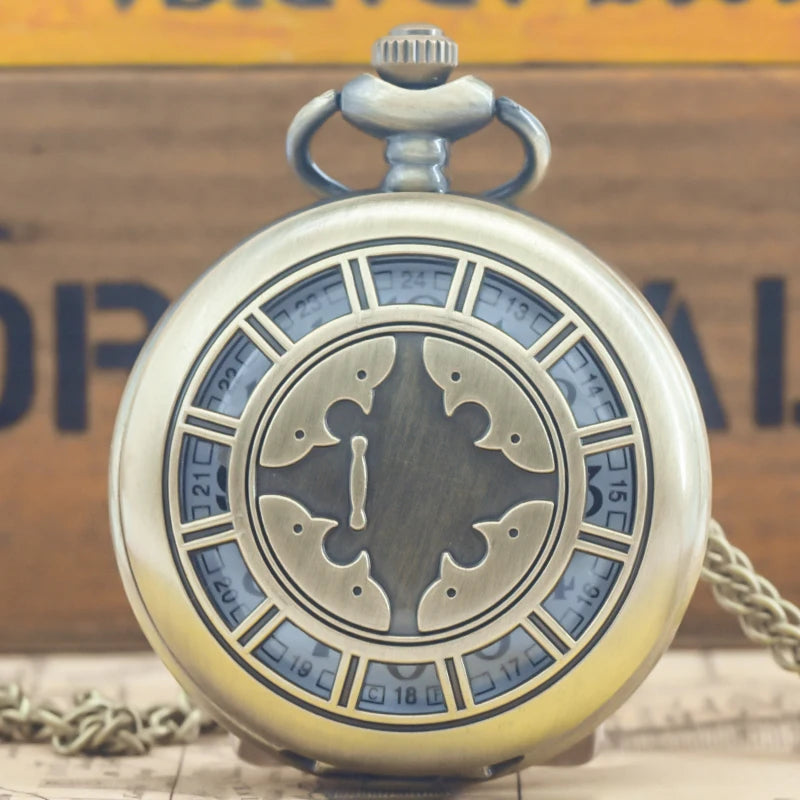
- Consider a 24-hour dial. Pieces such as our vintage bronze pocket watch with a 24-hour dial echo the inner 13 to 24 ring used on some North American railway watches, with an aged bronze finish that suits a period outfit.
- Case finish. Bronze and antiqued tones give an old-depot look, while silver tones feel closer to the nickel and silver cases conductors often carried. Our wider selection of vintage pocket watches covers both.
- Size and weight. Railroad watches were substantial. A watch that feels solid in the hand reads as more authentic than a small pendant piece.
If you are buying for someone else, many of the men’s pocket watches in the shop share the same open, readable layout and work well for retired railroaders, model train hobbyists or anyone drawn to classic timekeeping.
Railroad Pocket Watch Fobs and Chains
Railroaders needed their watches to be secure and quick to pull out. Many wore a short leather strap fob or a sturdy chain clipped to a belt loop or a vest buttonhole. Fobs carrying a railroad’s emblem, a locomotive or a union badge were popular keepsakes and are collected in their own right today.
For a modern piece, choose your attachment around how you dress:
- Jeans or work trousers: a short fob or a clip chain that hangs from a belt loop into the watch pocket.
- Vest or waistcoat: an Albert style chain with a T-bar through a buttonhole, which shows off the watch and keeps it secure.
- Gifts and display: a decorative fob turns the watch into a finished set that looks good in a box.
Our pocket watch fobs complete the look without hunting for cracked vintage straps.
Caring for Your Pocket Watch
Whether it is a century-old Hamilton or a modern quartz piece, a few habits help it last:
- Keep it away from water, magnets and hard knocks.
- Wipe the case with a soft dry cloth; harsh polishes can strip the patina from antiqued bronze.
- For a mechanical watch, wind it at roughly the same time each day and have it serviced by a watchmaker when it starts to lose accuracy.
- For a quartz watch, replace the battery promptly once it runs down so a dead cell does not leak into the movement.
Frequently Asked Questions
What makes a pocket watch “railroad grade”?
A railroad grade watch was built to meet a railroad’s approved standards: open face, crown at 12, lever setting, 16 or 18 size, a jeweled and adjusted mechanical movement, a legible dial with bold Arabic numerals, and accuracy within about 30 seconds per week, verified by a time inspector.
Why couldn’t railroad watches have a hunter case?
A hunter case adds a lid that has to be opened before the dial can be read. Railroads wanted crews to read the time instantly and with one hand, so open face cases became mandatory under most standards.
Are modern railroad pocket watches certified for railroad use?
No. Formal railroad watch inspection belongs to the era of timetable and train order operation. Modern railroad pocket watches are styled after the classic standards, with open faces and readable dials, but they are not certified service watches.
What is lever setting on a pocket watch?
Lever setting means the hands can only be adjusted after opening the bezel and pulling out a small lever beside the dial. It prevents the time from being changed accidentally when the crown is bumped or wound.
What is a railroad pocket watch fob?
It is a short strap or chain, often leather or metal, that attaches the watch to a belt loop or buttonhole. Railroad workers favored fobs because they kept the watch secure and easy to pull from a pocket, and many carried a railroad emblem.